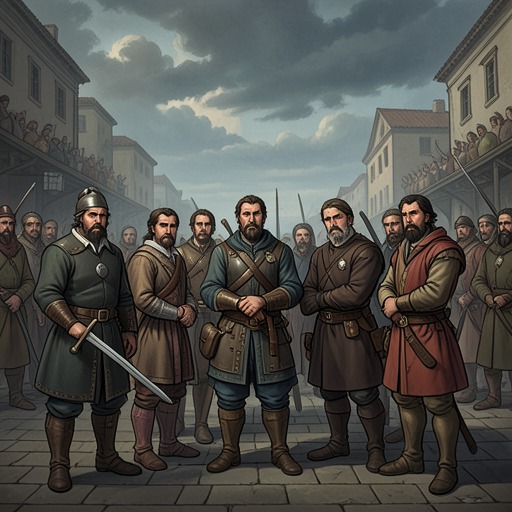
d'Artagnan–Rochefort
The Three Musketeersd'Artagnan–Rochefort is one of the novel’s clearest transformations from personal enmity into hard-won fellowship. At first, Rochefort is the elusive adversary who repeatedly appears at the edge of d'Artagnan’s crises: the stranger of Meung, the Rue des Fossoyeurs, and Arras, associated with the abduction of Madame Bonacieux and with the “horrible woman” whom d'Artagnan recognizes as Milady the English spy. Their conflict is therefore never merely a sequence of private quarrels. It joins d'Artagnan’s wounded pride and desire for revenge to the larger machinery of Cardinal Richelieu’s political power, until repeated encounters expose loyalty, restraint, and mutual respect beneath the hostility.
The Phantom and the Pursuer
The relationship begins in an atmosphere of incomplete recognition. D'Artagnan remembers Rochefort as the “cursed man” and his “evil genius,” a figure encountered whenever misfortune threatens. He had seen Rochefort accompanying Milady the English spy when he first met her, had been seeking him when he offended Athos, and had recognized him on the morning Madame Bonacieux was abducted. The recurrence makes Rochefort seem less like an ordinary opponent than a moving emblem of the hidden conspiracy surrounding d'Artagnan. Each sighting renews the young man’s sense that the same hostile force is crossing his path, even though Rochefort’s identity and purpose remain concealed.
This pattern also explains why recognition produces immediate violence. When Rochefort finally appears openly at a roadside cabaret, d'Artagnan does not wait for clarification: he raises his sword and springs toward the door. The stranger, however, does not flee. He dismounts and advances to meet him, reversing the established rhythm of pursuit. The old phantom has become a visible man, and the chase has become an official confrontation.
Authority and Arrest at La Rochelle
Rochefort identifies himself as the Chevalier de Rochefort, the equerry of Cardinal Richelieu, and announces that he has come in the king’s name to arrest d'Artagnan. He orders d'Artagnan to surrender his sword without resistance and warns that the matter concerns his head. The threat is political as much as physical: Rochefort speaks with delegated authority, while d'Artagnan stands exposed to the consequences of his service to the King and Queen of France and his opposition to the cardinal’s interests.
Athos intervenes by offering d'Artagnan’s word that he will go directly to La Rochelle, but Rochefort insists that the young man must be placed in the hands of guards who will conduct him to camp. This exchange shows the difference between the two men’s positions at that moment. Athos appeals to personal honor and the credibility of a gentleman; Rochefort represents the state’s coercive procedure. Their conflict is thus embedded in the novel’s rivalry between the King’s Musketeers and Cardinal Richelieu’s political network, rather than being reducible to individual hatred.
Yet Rochefort’s authority is not identical with blind cruelty. His later admission makes clear that he possessed the power to end d'Artagnan’s career, and perhaps his life, long before this arrest. The apparent persecution therefore contains an element of restraint: Rochefort has watched, reported, and pursued, but he has not used every weapon available to him.
The Hidden Debt Beneath the Rivalry
The relationship’s decisive reversal comes when Rochefort explains that he could have had d'Artagnan’s throat cut after their very first encounter simply by speaking a word to Cardinal Richelieu. That revelation changes the meaning of their earlier hostility. Rochefort had not been powerless, and d'Artagnan’s survival was not guaranteed by his own courage alone. The young Gascon’s career has unfolded within a dangerous hierarchy in which a cardinal’s favor, a royal commission, or a private accusation can determine whether a gentleman rises or disappears.
This hidden restraint echoes the moral code instilled in d'Artagnan by his father, who taught him to seek adventures, fear no quarrel, and endure nothing from anyone except the cardinal and the king. Rochefort belongs precisely to the sphere of the cardinal whom d'Artagnan’s father singled out as an exceptional authority. The relationship consequently tests the inherited ideal of courage against the realities of patronage and political power. D'Artagnan advances not simply by defeating enemies, but by surviving the institutions those enemies serve.
The same economy of obligation appears elsewhere in d'Artagnan’s conduct. When Buckingham attempts to repay him, d'Artagnan rejects the idea that his service was done for English gold, explaining that he acted for the queen and, indirectly, to please the woman he loved. His refusal establishes a distinction between honor and payment. Rochefort’s later confession similarly reveals that their relationship has never been a simple exchange of blows: political protection, withheld information, official duty, and personal judgment have all been moving beneath the visible combat.
Three Duels and a Reconciliation
After d'Artagnan’s appointment as lieutenant of the Musketeers, the old rivalry continues in a more controlled form. He fights Rochefort three times and wounds him three times. The repetition preserves the relationship’s combative identity, but the outcome is no longer the annihilation of an enemy. After the third encounter, d'Artagnan helps the wounded Rochefort to rise and remarks that he will probably kill him the fourth time. Rochefort answers that it is better for both of them to stop where they are, declaring that he is more d'Artagnan’s friend than the younger man thinks.
The phrase is significant because it recasts the entire history of pursuit. Rochefort’s friendship has existed alongside his service to Cardinal Richelieu, not outside the political world that made him d'Artagnan’s adversary. He further explains that, after the first encounter, he could have secured d'Artagnan’s death with a single word. The admission converts an apparently one-sided vendetta into a relationship marked by concealed forbearance. Rochefort has been dangerous, but he has also chosen limits.
The two men then embrace heartily and retain no malice. This physical gesture completes what the duels alone cannot accomplish. The sword remains central to their bond, but it has changed from an instrument of unresolved revenge into the medium through which each man recognizes the other’s courage. Their reconciliation does not erase the earlier arrests, threats, or political opposition; it absorbs them into a new understanding in which rivalry becomes proof of equality.
From Enemies to Allies in the Final Order
The reconciliation gains institutional force when d'Artagnan receives a lieutenant’s commission in the Musketeers from Cardinal Richelieu himself. The cardinal takes back one carte blanche and gives d'Artagnan another, leaving the name on the commission for d'Artagnan to write. D'Artagnan’s promotion places him within the official military structure that Rochefort serves, even though his rise has been shaped by conflicts with that same structure. The former pursuer and the former fugitive now occupy neighboring positions in the political and military order.
Their later relationship is therefore a form of conversion rather than a sentimental cancellation of the past. Rochefort remains associated with Richelieu, while d'Artagnan remains marked by loyalty to the King and Queen of France; nevertheless, their personal judgment exceeds the roles initially assigned to them. The relationship demonstrates that allegiance to a faction need not prevent recognition of an individual opponent’s worth.
In narrative terms, Rochefort functions first as a threshold guardian and recurring shadow, blocking d'Artagnan’s movement through the dangerous worlds of Paris, royal service, and political intrigue. By the end, he becomes evidence that the novel’s conflicts can produce unexpected alliances. D'Artagnan’s maturation is measured not only by his promotion but by his ability to distinguish an enemy’s office from the man who occupies it. Rochefort’s transformation is equally important: the “phantom” loses his supernatural aura and becomes a human rival capable of mercy, candor, and friendship. Their embrace closes the arc with a principle the novel repeatedly tests—that courage may begin a relationship, but mutual restraint and recognition are what finally make companionship possible.